Last month, Alex connected his wallet to what looked like a legitimate yield farming protocol. The website was slick. The TVL showed $50 million locked. The community was active. Ten minutes later, his wallet was empty--$85,000 gone. The worst part? A simple security check would have revealed the contract had an unprotected withdrawal function that let anyone drain user funds.
This keeps happening. Not because people are careless, but because nobody taught them what to actually check before hitting that "Approve" button.
The smart contract industry is handling $2.5 billion in value, and the OWASP just released their 2025 Top 10 vulnerabilities list. Translation: there are more ways to lose money than ever, but also more ways to protect yourself--if you know what to look for.
What You'll Understand After Reading This
You'll have a practical, step-by-step checklist you can run through in under 10 minutes before interacting with any smart contract. You'll know which red flags mean "run away immediately" and which yellow flags just mean "proceed with caution." Most importantly, you'll understand how to use both automated tools and manual checks to evaluate contract security--even if you can't read a single line of code.
This isn't about becoming a security auditor. It's about not becoming a victim.
The OWASP Top 10: Your Enemies List for 2025
Before you can protect yourself, you need to know what you're protecting against. The Open Web Application Security Project just updated their smart contract vulnerability list, and it's basically a greatest hits album of ways to lose money:
The Big Bad Ten
- Access Control Issues - When anyone can call admin functions (yes, this still happens)
- Oracle Manipulation - Making the contract believe lies about prices
- Logic Errors - The code doesn't do what developers think it does
- Missing Input Validation - Accepting garbage data that breaks everything
- Reentrancy - The "let me withdraw twice before you notice" trick
- Unchecked External Calls - Trusting other contracts blindly
- Flash Loan Attacks - Borrowing millions to break things in one transaction
- Integer Overflow - When 1 + 1 = 0 and your balance disappears
- Bad Randomness - "Random" numbers that aren't random
- DoS Attacks - Making contracts too expensive or impossible to use
If this sounds overwhelming, don't worry. You don't need to understand the technical details--you just need to know how to check if a contract is vulnerable.
The Pre-Flight Checklist: Before You Even Connect Your Wallet
Think of this like checking a used car before buying. You don't need to be a mechanic, but you should at least pop the hood and look for obvious problems.
Step 1: The Team and Transparency Check (2 minutes)
Who's Behind This?
- Can you find real names and faces? Anonymous teams aren't always bad, but it's a yellow flag
- Do they have LinkedIn profiles or GitHub histories? Real developers leave trails
- Is there an active Discord/Telegram with actual team participation?
Warning
Documentation Deep Dive:
- Is there a whitepaper that actually explains how things work?
- Can you understand what the protocol does after reading for 5 minutes?
- Do the tokenomics make sense, or is it just "number go up" hopium?
If the documentation reads like it was written by a caffeinated hamster or promises 50,000% APY with "no risk," that's not innovation--that's a scam.
Step 2: The Audit Hunt (3 minutes)
Audits are like health inspections for restaurants. Not perfect, but you definitely want to eat somewhere that passed one.
Finding Real Audits:
- Look for reports from recognized firms: CertiK, Trail of Bits, Hacken, OpenZeppelin
- Check the audit date--anything over 6 months old might miss recent changes
- Actually click the PDF and skim it (yes, really)
Reading Audit Reports (The Lazy Way):
- Jump to "Executive Summary" or "Findings Overview"
- Look for "Critical" or "High" severity issues
- Check if they were fixed (there should be a "Resolution" section)
- See if the audited code matches what's deployed (audit reports include commit hashes)
Danger
Step 3: The Code Verification Reality Check (2 minutes)
You don't need to read code, but you need to verify it exists and matches what was audited.
Quick Etherscan Check:
- Go to the contract on Etherscan (or equivalent explorer)
- Look for a green checkmark that says "Contract Source Code Verified"
- Check if it says "Similar Match Source Code" (means it's using standard, tested code)
- See when it was deployed--brand new = higher risk
What Unverified Means: The code could literally do anything, and you can't check. It's like signing a contract written in invisible ink.
The Technical Security Speed Run (For Non-Technical People)
Here's how to check for major vulnerabilities without knowing Solidity:
Access Control Quick Check
Look for these functions in the contract (Etherscan shows them):
- withdraw()
- pause()
- setOwner()
- mint()
Click on them. Do they have "onlyOwner" or similar restrictions? If not, anyone might be able to call them. That's terrifying.
The Reentrancy Red Flag
In the code, search for "nonReentrant" or "ReentrancyGuard". If the contract handles money but doesn't have these terms anywhere, it might be vulnerable to the classic "drain it twice" attack.
External Dependencies Check
Look for "import" statements at the top of the code. Good signs:
- Imports from OpenZeppelin (battle-tested code)
- Standard token interfaces (ERC20, ERC721)
Bad signs:
- Imports from unknown contracts
- Hardcoded addresses to external contracts
- No imports (means they wrote everything from scratch--risky)
The Token Approval Danger Zone
Token approvals are like giving someone a signed blank check. They can cash it whenever they want for however much you approved.
The Approval Safety Rules
- Never approve "unlimited" (shown as 115792089237316195423570985008687907853269984665640564039457584007913129639935)
- Approve exact amounts - If you're swapping 100 USDC, approve 100 USDC
- Revoke immediately after - Use revoke.cash to clean up
- Check existing approvals monthly - You'd be shocked what's lurking
Automated Tools: Your Robot Army
Let computers do the heavy lifting. Here are tools you can use right now:
Before Transaction Tools
Slither (via contract-library.com):
- Paste contract address
- Get instant vulnerability report
- Look for "High" severity issues
DeFi Safety (defisafety.com):
- Search for protocol name
- Get safety score (anything under 70% is risky)
- See detailed breakdown of what's missing
Token Sniffer (tokensniffer.com):
- Great for new tokens
- Shows if it's a honeypot (you can buy but can't sell)
- Identifies copycat scams
Real-Time Monitoring
Dedaub Contract Monitor:
- Set alerts for suspicious activity
- Monitor large withdrawals
- Track governance changes
Revoke.cash:
- See all your token approvals in one place
- One-click revoke for sketchy ones
- Set up alerts for new approvals
The Risk Assessment Matrix (Your Go/No-Go Decision Tool)
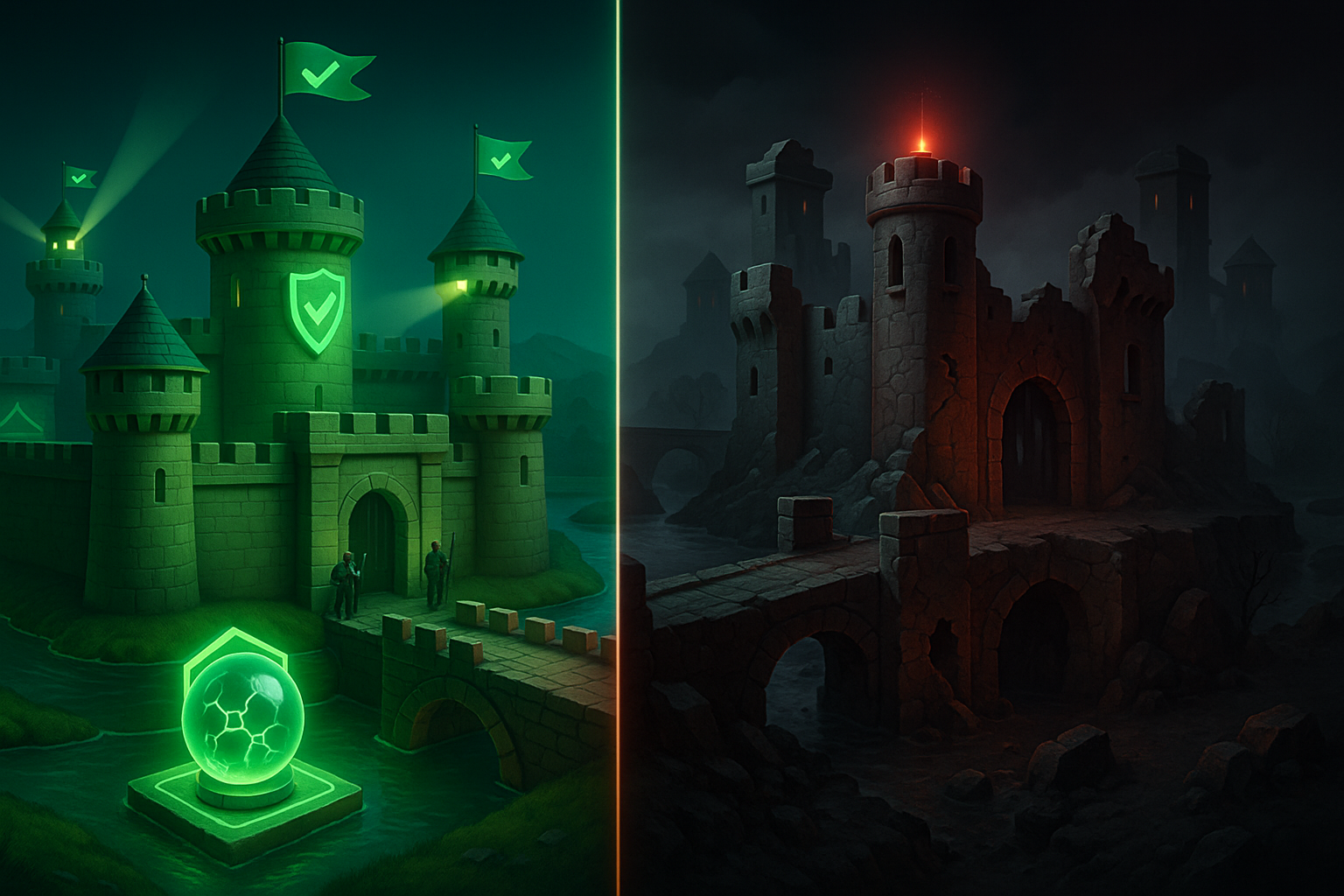
High Risk - Don't Touch With a Ten-Foot Pole
- No audits or fake audits
- Anonymous team with no history
- Closed source or unverified contracts
- Deployed less than a week ago
- Promises unrealistic returns (1000% APY)
- Contract can be paused or drained by single address
Medium Risk - Proceed With Extreme Caution
- Single audit from mid-tier firm
- Semi-anonymous but active team
- Limited documentation
- Some innovative features (translation: experimental)
- Minor past incidents that were fixed
Lower Risk - Still Be Careful
- Multiple audits from top firms
- Known team with track records
- Open source with good documentation
- Battle-tested for months/years
- Active bug bounty program
- Formal verification completed
Remember: Even "low risk" doesn't mean "no risk." Always use money you can afford to lose.

Your 10-Minute Security Routine
Here's your checklist in order:
- Team Check (2 min): Real people or ghosts?
- Audit Verification (3 min): Real audits or fake PDFs?
- Contract Verification (2 min): Verified on explorer?
- Function Check (1 min): Who can call what?
- Approval Check (1 min): How much are you risking?
- Automated Scan (1 min): What do robots think?
Tip
The Ultimate Smart Contract X-Ray Machine
Here's the thing about all these checks--they're great, but they assume you can interpret what you're seeing. What if you could just paste a contract address and get a plain English report of exactly what it can do?
That's where ChainDecode becomes your secret weapon. Instead of squinting at Solidity code hoping to spot issues, you get:
- Clear explanations of every function
- Who has what powers over the contract
- What approvals you're really giving
- Hidden fees or suspicious mechanisms
- Risk levels for different operations
It's like having a security auditor explain the contract to you in simple terms. Before you approve that next transaction, take 30 seconds to decode what you're really signing up for.
The New Reality of Smart Contract Security
Smart contract security in 2025 isn't about avoiding DeFi--it's about being smarter than the scammers. The tools exist. The knowledge is available. The question is whether you'll use them.
Every hack, every rug pull, every exploit requires victim participation at some point. Someone had to approve tokens. Someone had to ignore red flags. Someone had to trust without verifying.
Don't be someone. Be the person who takes 10 minutes to check. Be the person who revokes old approvals. Be the person who actually reads those audit reports (or at least the summary).
Because in the end, your security checklist isn't about just protecting money--it's about being able to sleep at night knowing you did your homework.
Stay safe out there. The degens need someone to keep them honest.