
In early 2024, Medium adjusted its recommendation algorithm and multiple writers reported traffic drops of 50-90% in public forums and blog posts. Most of them had no recourse. A few started looking for the exit.
That pattern repeats across every major publishing platform. Writers pour hours into research, craft arguments with care, hit "publish" - and from that moment forward, their words belong to someone else's algorithm, someone else's terms of service, someone else's bottom line.
In 2026, that tension has reached a breaking point. Writers aren't just frustrated anymore. They're leaving. And a growing number of them are heading toward something fundamentally different: OpenWord.io.
The Quiet Crisis in Digital Publishing
We don't talk about it enough, but the modern creator economy has a structural problem. The platforms that host written content - the Mediums, the Substacks, the social feeds - operate on a simple exchange: you create, they distribute. It sounds fair until you read the fine print.
Your article can be buried by an algorithm change overnight. Your account can be suspended without meaningful recourse. Your content can be scraped, repurposed, or quietly demonetized while the platform captures the lion's share of the value you created. And if you decide to leave? Good luck taking your audience, your publication history, or your proof of authorship with you.
Many writers across journalism, academia, and finance report the same frustrations: investigative journalists whose sensitive reports get taken down, academic researchers pressured by career incentives into publishing behind predatory paywalls, financial analysts whose market insights disappear at a platform's discretion, and long-form writers whose deep work is punished by engagement metrics designed for shallow content.
If you're new to blockchain concepts, our beginner's guide to smart contracts is a good starting point.
The web was supposed to democratize publishing. Instead, it concentrated power in the hands of a few gatekeepers wearing the mask of open platforms.
What OpenWord Actually Does Differently
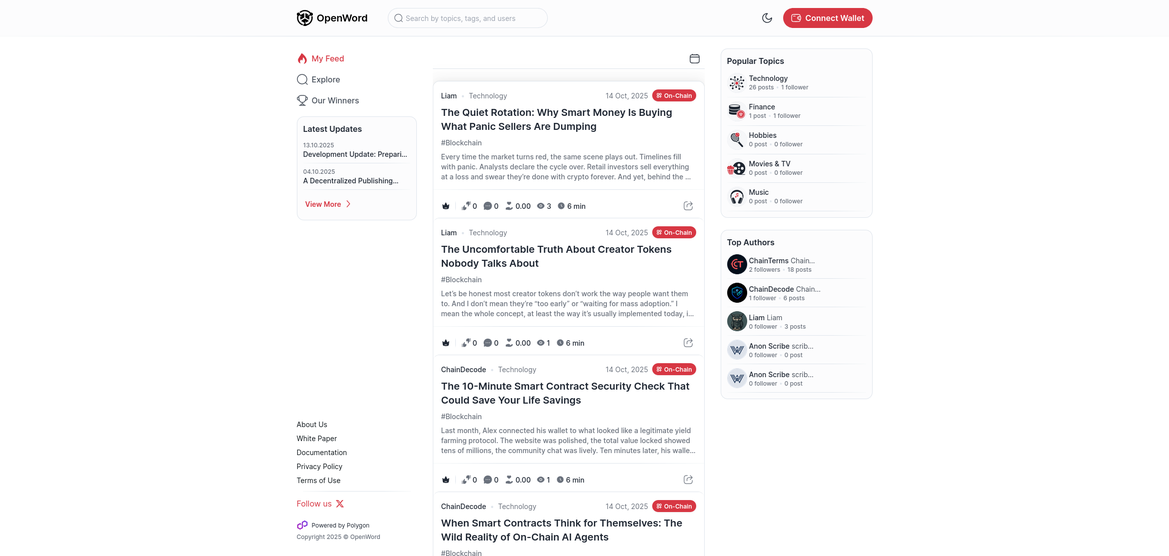
OpenWord is a decentralized publishing platform built on the Polygon blockchain, and it operates on a premise that sounds obvious but turns out to be radical: writers should own what they write.
When you publish on OpenWord, your article is minted as an NFT - a unique, verifiable digital asset tied to your wallet. That's not a gimmick or a speculative play. It gives writers something that has been difficult to achieve online at scale: cryptographically verifiable, transferable control over a token representing their work, with publication provenance anchored on a public blockchain.
Here's the key distinction: at the protocol level, your NFT lives on the Polygon blockchain and your content is stored on decentralized infrastructure - either IPFS with Arweave backup for long-term durability, or fully on-chain via SSTORE2 for strong immutability at the smart-contract level (with associated cost and public-visibility trade-offs). As long as the Polygon network and deployed contracts remain live and unchanged, the on-chain record of your publication cannot be unilaterally altered or removed by OpenWord or any other single party. Legal authorship rights still follow applicable law in your jurisdiction - but the cryptographic proof of when you published, and that you hold the token, is anchored on a public ledger.
The OpenWord.io interface, however, does curate what it surfaces - enforcing quality standards, plagiarism checks, and community guidelines at the UI layer. Editorial curation and infrastructural permanence are separate layers. The interface may choose not to display certain articles, but the underlying on-chain record and decentralized storage remain intact. Think of it like the difference between a book existing in a library and a bookstore choosing what to display in the window.
For a deeper look at how contract storage works and what to check before interacting, see our smart contract security checklist.
OpenWord isn't just a blockchain publishing tool, though. It's a complete ecosystem designed around the idea that quality writing deserves a sustainable economic model.
Built for Writers Who Take Their Craft Seriously
OpenWord intentionally avoids the dopamine-driven engagement loops that dominate mainstream platforms. It is built for writers and readers who value depth, substance, and intellectual honesty.
At the interface level, OpenWord enforces minimum word counts for publication, runs content through plagiarism detection and AI-content screening, and uses a progressive anti-spam system that keeps the noise floor low without punishing genuine contributors. These are curation decisions made by the platform's front end - not protocol-level censorship. Your on-chain ownership remains intact regardless. But for the reading experience, these filters mean that what surfaces on OpenWord.io has been held to a standard.
For readers, that means walking into a space where the writing is real, the authors are invested, and the content hasn't been optimized for clicks at the expense of truth. As AI-generated text floods search results and social feeds, a platform that screens for authentic human writing and enforces quality standards at the front end solves a problem that is only getting worse.
Monetization That Actually Serves the Creator
Traditional platforms take a significant cut of creator earnings and control how, when, and whether writers get paid. OpenWord flips this model.
Writers on OpenWord earn through direct tipping from readers, premium content sales, NFT transactions, and community quality rewards - and in every case, the vast majority of the revenue goes directly to the creator's wallet. There are no opaque payment schedules, no minimum thresholds before you see your money, and no intermediary deciding whether your content qualifies for monetization.
The platform also introduces a "Make Offer" system, where readers can negotiate directly with authors for content access or ownership. It's a flexible, human approach to monetization that treats writing as what it is: valuable intellectual property worth paying for.
For writers who produce premium content, OpenWord uses a quality staking mechanism. Authors lock OW tokens - currently set at five times the reader access fee - alongside each premium article, signaling confidence in the value of their work. Stakes are held for a defined challenge window; if an article is flagged for plagiarism or verified quality violations, part of the stake can be slashed. If no valid complaints arise, the stake is returned automatically. The result is a system that aligns incentives: creators who consistently deliver quality keep their stake and earn reader trust, while readers can evaluate premium content knowing the author has backed it with real commitment. Full staking parameters are documented at docs.openword.io.
Why 2026 Is the Year This Matters
By 2026, infrastructure, transaction costs, and wallet UX have improved enough that Web3 publishing can credibly compete with Web2 experiences. Polygon transactions routinely cost fractions of a cent. Wallet onboarding has simplified to a point where non-technical users can connect within minutes. And the cultural appetite is there - according to multiple industry surveys, creator dissatisfaction with centralized platforms has been climbing steadily, while interest in verifiable, human-created content continues to grow as AI-generated text saturates the web.
OpenWord arrives at this intersection with a fully thought-out ecosystem: an OW utility token that powers the platform's internal economy, community governance mechanisms that give users a voice in the platform's direction, and a roadmap that includes DAO governance, cross-chain expansion, and partnerships with cultural institutions and libraries.
This isn't a whitepaper that's waiting on funding. The core platform is deployed on Polygon, with content minting, anti-spam safeguards, and an early adopter program already in production. An initial cohort of writers is publishing on-chain - you can explore current activity and contract addresses at OpenWord.io.
For Investigative Journalists, Researchers, and Independent Thinkers
OpenWord's value proposition isn't theoretical - it maps directly to real problems faced by real writers.
Investigative journalists gain a platform where it is significantly harder for political or corporate actors to silently erase their work. Because publication records are written to the blockchain and content is stored on decentralized infrastructure, external pressure can target interfaces and indexing services but cannot easily eliminate the underlying record as long as the network persists. Pseudonymous wallet-based profiles decouple a writer's public identity from their published work. That said, blockchain publishing is pseudonymous, not anonymous - wallet funding paths and on-chain interactions can be traced through blockchain forensics. Journalists working with sensitive material should treat this as one layer of protection, not a complete OPSEC solution.
Academic researchers can bypass predatory journal paywalls and publish their findings with permanent, citable URLs. Peer verification tools and future research grant programs create a new model for scholarly communication that serves knowledge rather than publishing conglomerates.
Financial and crypto analysts can publish market insights without worrying about platform bias, content removal, or audience manipulation. Token-gated premium content lets them monetize expertise directly from the readers who value it.
Understanding the risks in DeFi is critical before using any token-gated system - our guide to DeFi scams covers the most common traps.
Essayists, cultural critics, and long-form writers finally have a home that values the kind of deep, considered work that mainstream platforms systematically undervalue. On OpenWord, thoughtful writing isn't an algorithmic liability - it's the entire point.
The Case for Authentic Content on the Blockchain
We're living through a moment where the very concept of authentic writing is under siege. AI can generate passable articles in seconds. Content farms pump out thousands of optimized posts per day. The signal-to-noise ratio on most platforms has collapsed.
OpenWord's answer isn't to ban technology or retreat into nostalgia. It's to build systems that make authenticity verifiable and valuable. Every post on OpenWord is tied to a real wallet. Every premium article is backed by a real stake. Every piece of content passes through quality checks before it surfaces on the platform. In a landscape drowning in synthetic noise, that kind of accountability is a competitive advantage - for writers and readers alike.
The blockchain doesn't just record transactions. It creates a transparent, tamper-proof record of who published what, when, and on which terms - with the full content preserved on decentralized storage. For the first time, the internet has a publishing infrastructure where provenance isn't just claimed - it's cryptographically verifiable.
Where to Start
If you're a writer who has ever felt the frustration of building on borrowed land - watching your work get buried, demonetized, or disappeared at someone else's discretion - OpenWord offers a genuine alternative.
Connect a Web3 wallet - OpenWord supports MetaMask and WalletConnect, and their getting started guide walks you through setup, funding a small amount of POL for gas fees, and securing your seed phrase. Publish your first piece. Watch it become an on-chain asset that no platform can unilaterally take from you.
Decentralized publishing is no longer theoretical. It's operational, and you can try it now at OpenWord.io.
This article was originally published on ChainDecode.com. OpenWord is a Web3 decentralized publishing platform on Polygon. For more information, visit OpenWord.io.