Alex thought he just needed a "quick definition." He'd been scrolling through crypto Twitter, came across a term he didn't recognize--RWA tokenization--and Googled it. Five hours later, he was still jumping between tabs, reading outdated blog posts, marketing fluff, Reddit threads, and several contradictory Medium articles.
And he still didn't know what the term actually meant.
If this sounds familiar, it's because Web3 education has a problem: the information is either too shallow, too technical, or too chaotic. And for millions of people, that barrier keeps them out of the crypto economy entirely.
ChainTerms was built to fix exactly this problem. In 2025, with 1,700+ definitions, 30 in-depth articles, and a blazing-fast static architecture, ChainTerms has become one of the internet's most trusted blockchain learning platforms--used from complete beginners to institutions exploring tokenized assets.
What You'll Understand After Reading This
You'll understand why ChainTerms exists, how its interactive glossary works, and what makes it unique compared to every other crypto dictionary or blog. You'll also see how it supports everyone--from a beginner trying to learn Bitcoin to an asset manager evaluating tokenized treasuries.
Most importantly, you'll know how ChainTerms turns blockchain complexity into clarity through structure, design, and content discipline.
The Problem With Blockchain Knowledge (And Why ChainTerms Had To Exist)
Blockchain is powerful, but the learning curve is steep. Not because the concepts are impossible--but because the internet is full of:
- Vague definitions that raise more questions than they answer
- Outdated information from 2017 that doesn't reflect current standards
- Contradictory explanations across different sources
- Hidden marketing agendas disguised as education
- Low-quality AI-generated content with no fact-checking
Even official documentation often requires three prerequisites before the real explanation begins.
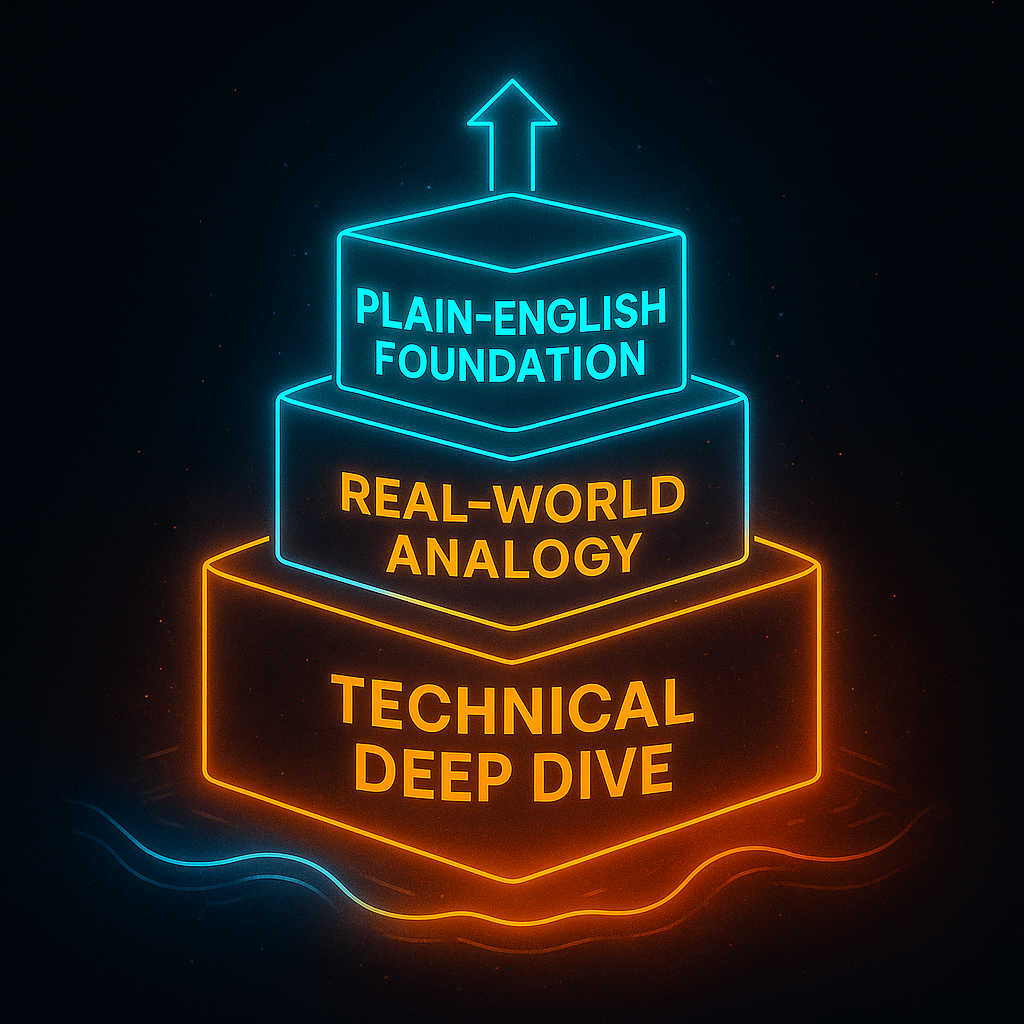
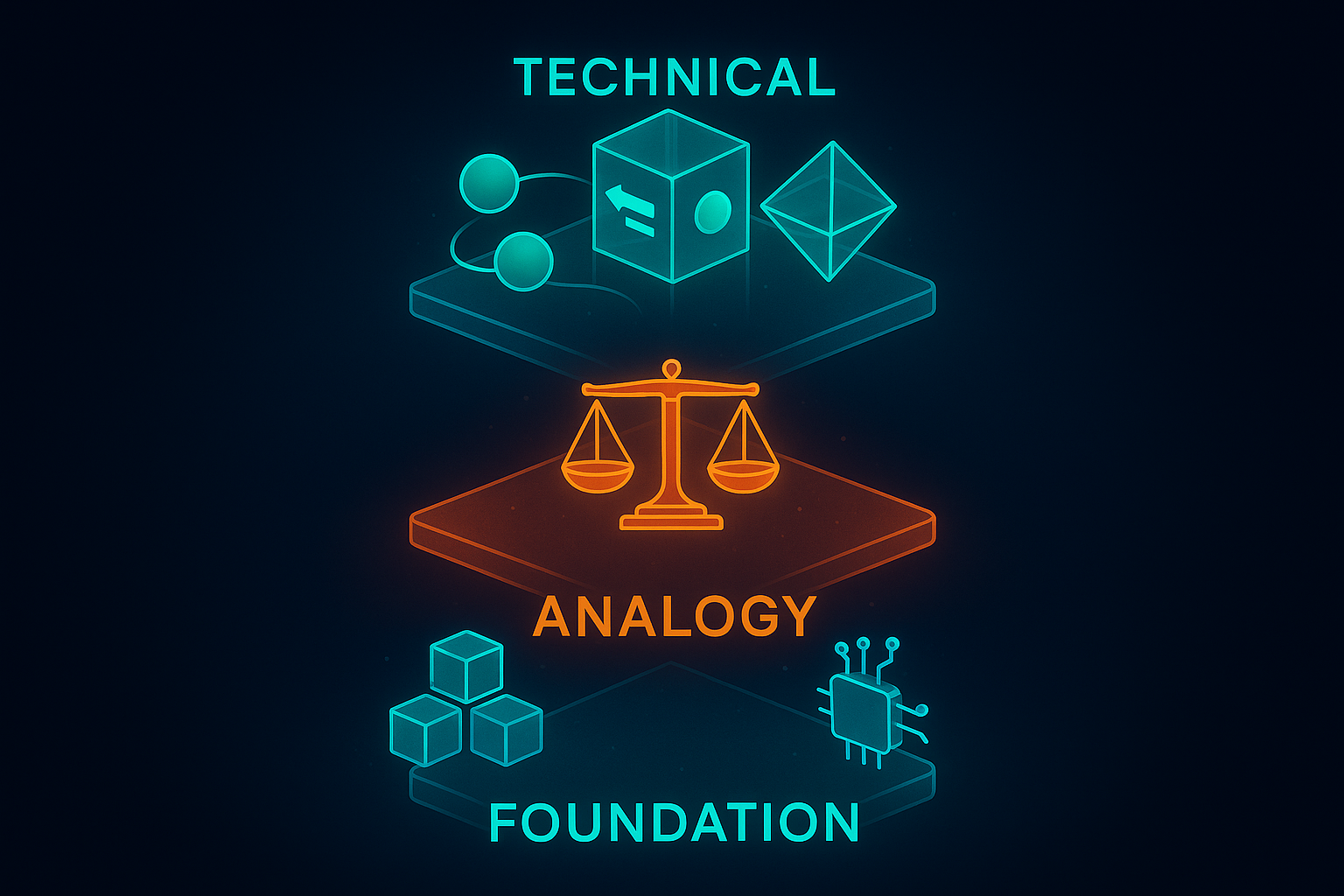
Why ChainTerms Works: The Three-Tier Learning Model
Every ChainTerms definition follows a structure that makes complex ideas digestible:
1. Plain-English Foundation
A beginner should grasp the concept without prior blockchain knowledge. No jargon, no assumed expertise--just clear explanation of what something is and why it matters.
2. Real-World Analogy
You get a mental image--like "a blockchain is a shared Google Doc you can't retroactively edit." Analogies bridge the gap between abstract concepts and familiar experiences.
3. Technical Deep Dive
Professionals and advanced users get the full, accurate breakdown. Protocol details, cryptographic specifics, implementation considerations--everything needed for serious work.
This ensures that someone unfamiliar with DeFi can understand the same page that a developer or institutional analyst reads--just from different layers.
The Interactive Glossary: 1,700+ Terms Designed for Instant Understanding
ChainTerms isn't a list--it's a full application disguised as a glossary.
Fast Search Built for Real Users
- Fuzzy search that finds terms even with typos
- Typo tolerance so "tokeization" still finds "tokenization"
- Debounced input for smooth typing without lag
- Mobile-first optimization for thumb-driven navigation
- Indexed state management for instant results
- Under 100ms response time for most queries
Searching "ETH staking" or "tokeization" (misspelled) still gets you where you need to go.
Cross-Referenced Learning Paths
Terms link to related concepts, forming natural learning journeys. "One term leads to another, but without falling into a Wikipedia rabbit hole."
If you're reading about staking, you'll see links to validators, proof-of-stake, and slashing. Each connection is intentional, guiding you through progressively deeper understanding.
Two Reading Modes
- Detailed cards for in-depth learning with full three-tier explanations
- Compact grid for rapid browsing and quick reference lookups
Mobile Glossary Enhancements
ChainTerms received a major mobile revamp in January 2025, including:
- Horizontal letter navigation for quick alphabetical jumps
- Skeleton loaders that show content structure while loading
- Lazy and chunked rendering for smooth scrolling through thousands of terms
- Touch-optimized layout with thumb-friendly tap targets
- Session-based search history for returning to previous lookups
The glossary works as smoothly on a phone as on a desktop--something few Web3 sites can claim.
Beyond Definitions: 30 Deep-Dive Articles
ChainTerms is more than definitions. It includes 30 articles, each 4,000-6,000 words, covering:
Digital Assets Foundation
- How Blockchain Works - The technical fundamentals explained clearly
- What Are Digital Assets - Taxonomy and classification frameworks
- Stablecoins and NFTs - Use cases and implementation patterns
- Wallet Security - Best practices and threat models
RWA Tokenization Series (10 Articles)
The most complete free resource on Real-World Assets (RWAs):
- Tokenization Explained - Core concepts and mechanisms
- Market Size Analysis - Current adoption and projections
- Token Lifecycle - Issuance, trading, redemption, settlement
- Legal Frameworks - Regulatory compliance across jurisdictions
- DeFi Integration - How tokenized assets interact with protocols
- Bankruptcy Protection - Legal isolation and creditor hierarchy
- Regulation Overview - SEC, MiCA, and global standards
- Portfolio Frameworks - Institutional asset allocation strategies
- Real Estate Use Cases - Property tokenization mechanics
Institutional Analysis
Case studies on:
- BlackRock - BUIDL fund and tokenized treasury approach
- Franklin Templeton - OnChain U.S. Government Money Fund
- JPMorgan - Onyx blockchain and institutional DLT
- BNY Mellon - Custody and tokenization services
- Ondo Finance - Tokenized treasuries and credit
- Singapore's Project Guardian - Central bank digital experiments
Clear, factual, unbiased--no hype, no speculation.
Technical Infrastructure
Guides on:
- Ethereum vs Polygon vs Avalanche - Architecture comparisons
- Oracles (Chainlink) - Off-chain data integration
- ERC-3643 - Permissioned token standard
- On-chain Compliance - Automated KYC/AML enforcement
- KYC/AML Frameworks - Identity verification systems
- Custody Solutions - Institutional-grade storage
- Global Regulations - Jurisdiction-specific requirements
Every article uses modern pedagogy and strict accuracy standards.
Design That Makes Learning Feel Effortless
ChainTerms uses a fully professional, accessibility-first design system:
Clean Typography & Modular CSS
A readable, modern interface using:
- CSS variables for consistent theming
- BEM-like architecture for maintainable styles
- Responsive design that adapts to any screen
- Optimized layouts for readability and scanning
- SVG-based illustrations for crisp visuals at any resolution
Lightning-Fast Static Architecture
No frameworks, no bloat. Just pure HTML, CSS, and JavaScript, with client-side JSON (~2.5MB) loaded into memory for instant browsing.
Performance Highlights
- 2-3 second load time on average connections
- ~0.8s First Contentful Paint for perceived speed
- Static hosting compatible - works on any CDN
- Zero server-side rendering - pure client-side performance
- Works offline with planned PWA upgrade
- Privacy-focused analytics - no cookies, no tracking invasions
Why ChainTerms Stands Out (Compared To Everything Else)
1. Depth & Quality
Most glossaries give 1-2 lines per term. ChainTerms gives layered explanations + security notes + analogies + technical details. You don't just get definitions--you get understanding.
2. Institutional Credibility
Used in:
- University courses for blockchain and finance programs
- Corporate training at traditional finance institutions
- RWA research by analysts and investment teams
- Investor education programs for accredited and retail investors
3. Privacy First
No ads. No tracking. No surveillance. ChainTerms respects your privacy the same way it respects your time--completely.
4. Speed
The glossary loads instantly--even with 1,700 items--thanks to chunked rendering, requestIdleCallback, and optimized state management. Most queries return results in under 100 milliseconds.
5. Zero-Friction Learning
No account needed. No popups. No paywalls. Just pure education.
Tip
Real Use Cases: Who Actually Benefits From ChainTerms?
Beginners & Casual Users
Understand crypto without jargon. Start with simple definitions, explore analogies, and gradually build knowledge through connected terms.
Developers
Quick reference for standards, concepts, and protocol terminology. Look up ERC token standards, consensus mechanisms, or cryptographic primitives without wading through whitepapers.
Investors
Learn tokenization frameworks, stablecoin mechanics, and RWA structures. Understand what you're investing in before committing capital.
Institutional Teams
Use the RWA series and regulatory guides for onboarding traditional finance professionals into blockchain. Bridge the knowledge gap between TradFi and DeFi.
Educators
Use the glossary and articles for coursework and assignments. Reliable, accurate content that students can cite and trust.
ChainTerms intentionally avoids hype and speculation. Its focus is clarity, accuracy, and long-term educational value.
Technical Backbone: Clean, Future-Proof Architecture
ChainTerms is built on a modern yet simple foundation:
- Vanilla JavaScript ES6+ - no frameworks, no dependencies
- Semantic HTML5 - proper structure for accessibility
- CSS3 custom properties - flexible theming system
- Client-side JSON database - ~2.5MB loaded in memory
- SVG illustrations - scalable graphics
- State management using local/session storage
- Fully modular JS files - maintainable codebase
No frameworks, no server-side dependencies. This avoids maintenance issues and keeps performance high. The entire codebase is straightforward JavaScript that will work for years without major refactoring.
The Bottom Line: Why ChainTerms Matters in 2025 and Beyond
Crypto adoption isn't blocked by technology--it's blocked by understanding.
ChainTerms exists to eliminate that barrier.
By delivering:
- Accurate definitions with three-tier explanations
- Real-world analogies that make concepts tangible
- Institutional-level analysis for serious research
- Exceptional speed and design that respects your time
- Zero-friction access with complete privacy
ChainTerms becomes more than a glossary. It becomes the educational backbone of the tokenized economy.
If blockchain is the future of finance, ChainTerms is the dictionary of that future.
Alex eventually figured out what RWA tokenization meant. But it took him five hours because ChainTerms didn't exist yet when he started searching. Now, that same question gets answered in 30 seconds. That's the difference education architecture makes.