Marcus had been trading on Ethereum for two years. He knew his way around Etherscan, understood gas fees, and could spot a honeypot contract from a mile away. Then he tried Solana. Within five minutes, he was staring at Solscan completely lost: "Why does my wallet need to pay 'rent'? What's a 'Program' versus a 'Smart Contract'? And why does this token say it has 'Freeze Authority' over my funds?"
Welcome to Solana -- where transactions cost fractions of a penny, settle in 400 milliseconds, and the learning curve feels like switching from Windows to Linux without a manual.
Here's the thing: Solana processes 65,000 transactions per second while Ethereum struggles with 15. It's legitimately fast and legitimately cheap. But speed comes with complexity, and that complexity creates blind spots where scams hide. If you don't understand how Solana's architecture fundamentally differs from EVM chains, you're flying blind with real money on the line.
What You'll Understand After Reading This
You'll finally understand why everything on Solana is called an "Account" and how that's completely different from Ethereum's approach. You'll know the critical difference between SPL tokens and the new Token-2022 standard (spoiler: one can charge fees on every transfer you make). Most importantly, you'll learn how to use ChainDecode to identify the three most dangerous authority risks in Solana tokens before you invest a single SOL.
By the end, Solana will stop feeling like alien technology and start making architectural sense -- even if you never write a line of Rust code.
Programs vs. Smart Contracts: The Core Architecture Difference
The first mind-bending thing about Solana is that it doesn't have "smart contracts" in the Ethereum sense. It has Programs. And understanding this distinction is the key to everything else.
Ethereum's Approach: The Self-Contained Package
On Ethereum, a smart contract is like a self-storage unit. The code lives there, your balance lives there, the contract's state lives there -- everything bundled together. When you call a function, you're interacting with this single entity that manages both logic and data.
Simple? Yes. Efficient? Not really. Every contract duplicates storage mechanisms, and you pay gas for every tiny state change.
Solana's Approach: Everything Is an Account
Solana took a radically different approach. Programs are stateless -- they contain only executable code, no data storage. All data lives in Accounts, which are basically specialized storage containers.
Think of it like your computer's operating system:
- Programs = Applications (Word, Chrome, Calculator)
- Accounts = Files and folders (your documents, settings, databases)
- Programs read and modify accounts, but don't store data themselves
When you send a transaction on Solana, you're basically saying: "Hey, TokenProgram, please modify MyWalletAccount and RecipientWalletAccount by transferring X tokens."
Why This Matters for Security
This separation creates unique attack vectors that don't exist on Ethereum:
- Account Ownership Confusion: Every account is owned by a program. If you don't verify which program owns your token account, you might be interacting with a fake.
- Cross-Program Invocation Risks: Programs can call other programs. A token transfer might trigger three different programs in one transaction -- each a potential vulnerability.
- Rent Mechanics: Accounts must maintain minimum balances or get deleted. Some scams exploit rent collection to drain funds gradually.
The Rent Situation Nobody Warned You About
Here's something Marcus discovered the hard way: Solana accounts pay rent to exist on the blockchain. If your account balance falls below the rent-exempt threshold (about 0.00089 SOL for a basic token account), it can be "garbage collected" and disappear.
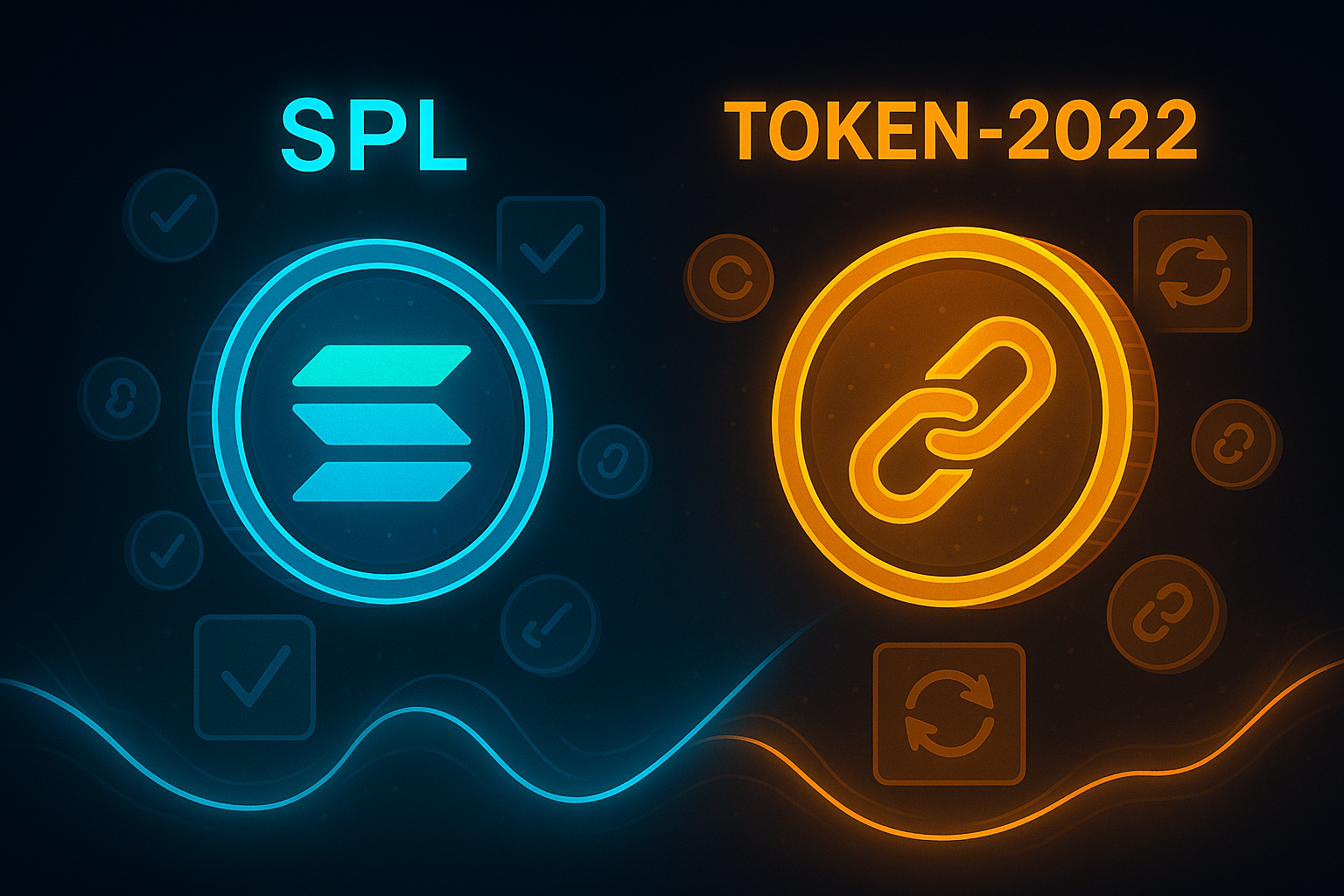
The Token Zoo: SPL vs. Token-2022
Just when you thought you understood tokens, Solana throws you a curveball: there are now two competing token standards, and choosing the wrong one can cost you money on every single transaction.
SPL Token: The Original Standard
SPL Token (Solana Program Library Token) is the original standard, roughly equivalent to Ethereum's ERC-20. It does the basics:
- Mint new tokens into circulation
- Transfer tokens between accounts
- Burn tokens permanently
- Approve delegates to spend on your behalf
SPL tokens are straightforward, battle-tested, and well-understood. The risk model is similar to ERC-20: watch for unlimited mint authority and approval scams.
Token-2022: The Powerful New Kid
Token-2022 (also called Token Extensions) is the new extensible standard that launched in 2024. It supports everything SPL can do, plus a bunch of advanced features:
- Transfer Fees: Built-in taxation on every transaction (e.g., 2% fee on all transfers)
- Transfer Hooks: Custom code runs on every transfer (can block transactions)
- Permanent Delegate: A designated account that can always transfer tokens (even from your wallet)
- Confidential Transfers: Zero-knowledge proofs hide amounts
- Metadata Extension: On-chain name, symbol, and URI
- Interest-Bearing Tokens: Built-in yield mechanisms
Sounds powerful, right? It is. But each extension introduces new risk vectors.
The Hidden Costs of Token Extensions
Warning
Let's talk about Transfer Fees -- the feature that can quietly drain your holdings. Say you buy a Token-2022 token with a 5% transfer fee. Here's what happens:
- You buy 1000 tokens - Pay 5% fee - Actually receive 950 tokens
- You transfer to another wallet - Pay 5% fee - 902.5 tokens arrive
- You sell on a DEX - Pay 5% fee - 857 tokens sold
You lost 14.3% of your holdings to transfer fees alone, not including trading slippage or exchange fees. And here's the kicker: the team controls where those fees go. They accumulate in a designated account they can withdraw from anytime.
It's like a tax you didn't agree to, charged by people who aren't a government.
How to Identify Token Standards
When analyzing a Solana token, check which program owns it:
- SPL Token:
TokenkegQfeZyiNwAJbNbGKPFXCWuBvf9Ss623VQ5DA - Token-2022:
TokenzQdBNbLqP5VEhdkAS6EPFLC1PHnBqCXEpPxuEb
ChainDecode automatically identifies the standard and shows you exactly which extensions are active. If you see "Transfer Fee" in the extension list, you know to check the rate before buying.
The Dark Side: Upgrade Authority and Freeze Authority
Now we get to the really scary stuff -- the administrative powers that let developers control your funds even after you've "bought" them.
Upgrade Authority: The Mutable Program Problem
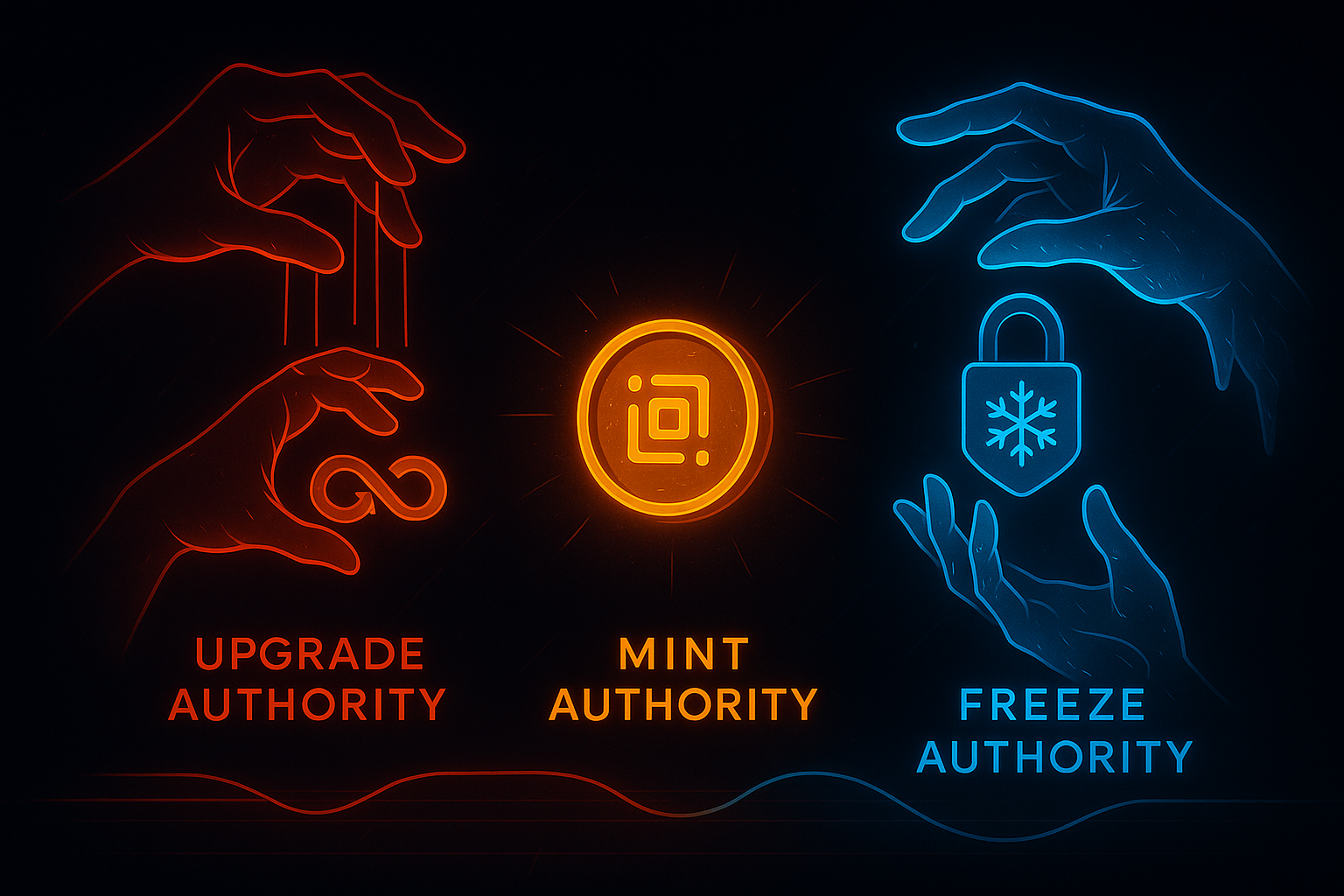
Remember how Solana programs are stateless code? Well, most programs are upgradable by default. If a program has an Upgrade Authority, whoever holds that authority can replace the entire program code at any time.
Think about that for a second. You analyzed the program code, verified it was safe, then invested $10,000. The next day, the developers upgrade the program with a hidden drain_all_wallets() function. Your analysis is now worthless -- you're trusting code that no longer exists.
Immutable vs. Mutable Programs
- Immutable Program: Upgrade Authority has been permanently removed (set to null). The code cannot change, ever. What you see is what you get forever.
- Mutable Program: Upgrade Authority is still controlled by a wallet or governance mechanism. Code can be changed at any time by the authority holder.
Danger
Mint Authority: The Inflation Weapon
Mint Authority is the power to create new tokens out of thin air. As long as it exists, the token supply can be inflated indefinitely.
Legitimate projects renounce Mint Authority after initial distribution. Scam projects keep it active and quietly mint millions of tokens, then dump on unsuspecting buyers.
ChainDecode shows you:
- Whether Mint Authority exists
- Which account controls it (multisig or single wallet?)
- Historical mint events (have they minted recently?)
Freeze Authority: The Censorship Superpower
This is the most dystopian feature. Freeze Authority lets the token creator freeze ANY account holding their token. Once frozen, you can't transfer, sell, or do anything with those tokens. They're still in your wallet, but completely locked.
Why does this exist? Legitimate use cases include:
- Regulatory compliance (freezing sanctioned addresses)
- Security response (freezing hacked accounts)
- Escrow mechanisms (freezing until conditions are met)
But the potential for abuse is obvious. A malicious team can:
- Pump the token price
- Freeze all wallets except their own
- Dump their holdings while everyone else is locked out
- Unfreeze accounts after the dump
Protection Strategy: Always check if Freeze Authority has been renounced. If it hasn't, you're trusting the team not to abuse god-mode powers over your holdings.
How ChainDecode Decodes Solana
All of this complexity is why we built Solana support into ChainDecode. Because reading raw Rust code and parsing account structures is not something anyone should have to do before buying a token.
The Composite Solana Risk Score (CSRS)
When you paste a Solana token address into ChainDecode, you immediately get a CSRS (Composite Solana Risk Score) from 0-100:
- 0-30 (Low Risk): Immutable program, all authorities renounced, SPL standard
- 31-60 (Medium Risk): Some authorities present but controlled by multisig, or Token-2022 with reasonable extensions
- 61-85 (High Risk): Mutable program or active Freeze Authority with single-wallet control
- 86-100 (Critical Risk): Multiple red flags -- mutable program, active Mint Authority, Freeze Authority, suspicious transfer fees
The score aggregates risks across program mutability, authority status, token standard, and historical behavior patterns.
Authority Analysis Dashboard
ChainDecode breaks down each authority type with a visual dashboard:
- Mint Authority: Status (Active/Renounced), controlling address, recent mint events
- Freeze Authority: Status, controlling address, historical freeze operations
- Upgrade Authority: Status, program mutability, last upgrade timestamp
Each authority gets a severity rating with a plain-English explanation:
"High Risk: Mint Authority is active and controlled by a single wallet (7xK9...3Qm). The team can create unlimited new tokens at any time, diluting your holdings to zero."
Instruction Cards: What Can This Token Actually Do?
One of the most powerful features is the Instruction Breakdown. ChainDecode analyzes every instruction the token program supports and explains them in simple terms:
- Transfer: "Standard Operation - Normal token transfer between users. No special permissions required."
- MintTo: "Inflation Risk - Developer can create unlimited new tokens, diluting the value of your holdings."
- Burn: "Deflationary Action - Reduces supply to increase token value. Generally positive."
- FreezeAccount: "Censorship Risk - Developer can freeze your tokens at will, preventing you from selling or moving them."
- ThawAccount: "Access Restoration - Reverses freeze, but the power imbalance remains."
- SetAuthority: "Critical Governance Event - Can renounce or transfer authority. Watch closely."
Each card expands with technical details, real-world analogies, and specific risk assessments. You don't need to understand Rust syntax to know that "FreezeAccount" means the team can lock you out of your own tokens.
Token-2022 Extension Detection
If a token uses Token-2022, ChainDecode automatically identifies and explains each active extension:
- Transfer Fee: Shows exact fee percentage, where fees accumulate, who can withdraw them
- Transfer Hook: Identifies the hook program, explains what custom logic runs on transfers
- Permanent Delegate: Shows which account has unlimited transfer power
- Confidential Transfers: Notes privacy features and their implications
No more surprises when 5% of your trade disappears to "protocol fees" you didn't know existed.
Real-World Solana Security Checklist
Before buying any Solana token, run through this checklist using ChainDecode:
Authority Verification
- [ ] Mint Authority renounced or controlled by DAO
- [ ] Freeze Authority renounced (or clear justification why not)
- [ ] Upgrade Authority removed (program is immutable)
Token Standard Check
- [ ] Identify if SPL or Token-2022
- [ ] If Token-2022, review all active extensions
- [ ] Check for transfer fees and calculate real trading cost
- [ ] Verify no dangerous Transfer Hooks
Program Analysis
- [ ] Verify program owner matches expected standard (SPL or Token-2022)
- [ ] Check for custom programs with unknown behavior
- [ ] Confirm rent-exempt status for your token accounts
Historical Behavior
- [ ] Review past mint events (sudden supply inflations?)
- [ ] Check for freeze/thaw operations (has team frozen users before?)
- [ ] Look at program upgrade history (frequent changes = unstable)
Composite Risk Assessment
- [ ] CSRS under 60 for significant investments
- [ ] No critical flags (score 86+) unless you're a degen gambler
- [ ] Team transparency (public identities, social media, documentation)
The Bottom Line: Solana Is Fast, But Not Simple
Solana's speed and cost advantages are real. 400-millisecond finality and sub-cent fees enable use cases Ethereum can't touch. But that performance comes from architectural decisions that create complexity -- and complexity creates attack surface.
The account model, mutable programs, dual token standards, and authority systems are all powerful features. In the right hands, they enable innovation. In the wrong hands, they enable sophisticated scams that look legitimate until it's too late.
You don't need to become a Rust developer to invest safely on Solana. But you do need to understand the unique risk vectors -- and you need tools that translate program code into human-readable risk assessments.
Tip
Marcus eventually figured it out. After losing 2 SOL to a token with active Freeze Authority, he started using ChainDecode for every new token. He's still on Solana -- the speed really is addictive -- but now he checks the authorities first.
Be like Marcus. Just skip the 2 SOL lesson.